.jpg)
The Blacktip Reef Shark in Thailand: Complete Guide, Behavior, Habitat and Sightings in Koh Phi Phi and Maya Bay

The Blacktip Reef Shark: A Star of Tropical Reefs
Imagine yourself on a white-sand beach in Thailand or the Maldives. You walk into warm, shallow water when you suddenly spot a small pointed fin at the surface. Don't panic: you have probably just encountered the blacktip reef shark, one of the best-known inhabitants of tropical reefs.
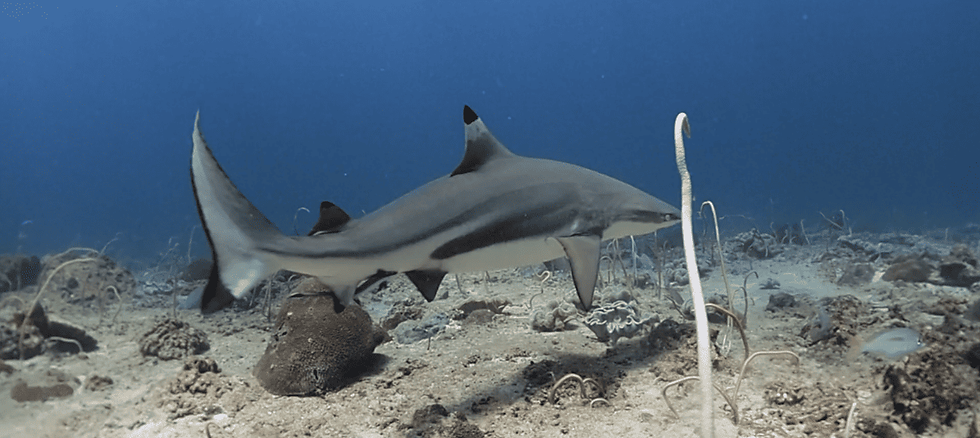
It is easy to recognize. The tips of its fins are marked with black. On its first dorsal fin, the black tip is particularly visible and highlighted by a white band. This very distinctive silhouette has even earned it the nickname “Aston Martin” of the sea, referring to its proportions and appearance.
Its scientific name is Carcharhinus melanopterus. This name comes from Ancient Greek and literally means “black wing” or “black fin”. It is mainly found in the warm, shallow waters of the Indian and Pacific Oceans, often near coral reefs.
Its appearance may be impressive, but its behavior towards humans is generally very different from that of the aggressive sharks shown in some movies. It is rather shy and timid. For scientists, its presence can also provide an interesting indication of the condition of a coral reef.
In regions such as Thailand, the Maldives, Indonesia and Polynesia, it is one of the animals that divers and snorkelers often hope to encounter.
At Koh Phi Phi, it is possible to observe it while scuba diving, snorkeling and even from the water's edge at Maya Bay.
Carcharhinus melanopterus: Its Scientific Identity Card
To identify a species precisely, scientists use taxonomy. The name Carcharhinus melanopterus distinguishes this shark from its relatives.
“Carcharhinus” comes from karcharos, meaning sharp or serrated, and rhinus, associated with the nose or a rasp. The name notably refers to its sharp teeth and the texture of its skin.
“Melanopterus” combines melas, meaning black, and pteron, meaning wing or fin. The full name can therefore be translated as “black wing”. For a shark whose fins appear to have been dipped in black ink, the name is quite appropriate.
The species was first described in 1824 by the French explorers and naturalists Jean René Constant Quoy and Joseph Paul Gaimard, during their voyage around the world aboard the ship L'Uranie. The first official specimen was found near an island in New Guinea.
Since 1965, the blacktip reef shark has been the model species, or “type species”, of the genus Carcharhinus.
It belongs to the family Carcharhinidae, often referred to as the “requiem sharks”. Depending on the region, it is known by several names:
In French: blacktip reef shark
In English: Blacktip reef shark
In Hawaii: Mano pa'ele
A fairly common confusion should be avoided. The blacktip reef shark should not be confused with the blacktip shark, which is also sometimes called “blacktip” in English. The latter lives farther offshore and can become much larger and more massive.

How to Recognize a Blacktip Reef Shark
The first clue is obvious when you see one at close range: the black tips of its fins. The first dorsal fin is particularly characteristic, with its black tip highlighted by a clearly visible white band.
The body is robust and streamlined, with a torpedo-like shape adapted to fast swimming. The head is broad and the snout is relatively short and rounded.
An adult generally measures around 1.60 meters, although exceptional individuals can reach 2 meters.
The back is gray-brown while the underside is white. This difference in coloration corresponds to a camouflage strategy called countershading. A horizontal white line also appears along the sides, from the pectoral fin to the rear of the body.
Its teeth are triangular and serrated, like small saws. This shape allows it to grip slippery fish more easily.
Its eyes are medium-sized and oval. The nostrils have a small specialized flap of skin involved in detecting odors.
The pectoral fins are falcate, meaning they are shaped like a sickle. This shape gives it considerable agility when moving between coral formations.
A Perfectly Adapted Anatomy for Underwater Life
Like other sharks, the blacktip reef shark does not have a skeleton made of hard bones. Its skeleton is made of cartilage, a flexible material comparable to that which makes up our nose and ears.
This structure is lighter than bone and allows it to swim rapidly while limiting its energy expenditure.
Its weight rarely exceeds around fifteen kilograms, even for the largest specimens.
It does not have a swim bladder. To remain suspended in the water column, it uses its pectoral fins like the wings of an airplane to generate the force necessary for buoyancy.
Its metabolism is high and its oxygen requirements are significant. It often needs to keep swimming to circulate oxygenated water across its large gill slits.
Its jaws have another particular feature. They are not rigidly attached to the skull and can project forward, allowing it to rapidly suck in prey.
Its skin is covered with thousands of tiny structures called dermal denticles. They look like tiny teeth and reduce water friction. The shark can therefore move with less resistance.
It also has a rather unusual digestive strategy. It can rest in very shallow waters warmed by the sun. The heat accelerates its metabolism and helps it transform food into energy more quickly before another hunting period.

Extremely Highly Developed Senses
The blacktip reef shark possesses several highly efficient sensory systems. They help it locate prey, avoid obstacles and monitor what is happening around it.
A Highly Developed Sense of Smell and Hearing
Its sense of smell allows it to detect extremely low concentrations of blood and other chemical signals from a long distance. It also uses this sense during reproduction to detect certain pheromones.
Its inner ear detects low-frequency sounds. It can notably perceive the vibrations produced by an injured fish before it even enters its field of vision.
Vision Adapted to Coral Reefs
Its eyes contain a reflective structure called the tapetum lucidum. It acts like a mirror and amplifies light, helping it see when brightness decreases.
The shark is particularly sensitive to movements and contrasts at a distance of 1.5 to 3 meters.
To protect its eyes during a fight or while attacking prey, it has a nictitating membrane, a transparent third eyelid that covers the eye.
The Lateral Line: Sensing Water Movements
Along its sides and head is a lateral line made up of fluid-filled canals. Specialized cells called neuromasts detect small vibrations and changes in water pressure.
This system allows it to build a hydrodynamic representation of its environment and avoid obstacles, even in complete darkness.
The Ampullae of Lorenzini: Its Sixth Sense
Around its snout are the ampullae of Lorenzini, small pores filled with conductive gel. They detect the electrical fields produced by living organisms, including heartbeats and muscle movements.
This ability is particularly useful when prey is hidden under the sand or when the shark hunts at night.
A Highly Precise Attack Sequence
When hunting, the shark uses its senses in a fairly precise sequence. Smell and hearing come into play first at a distance. As it approaches, vision and the lateral line take over. Finally, electroreception may intervene at the last moment, just before the bite.
Despite this arsenal, the estimated success rate of an attack during a normal hunt is between 15 and 30%. This rate can increase when conditions are favorable, particularly during an outgoing tide, at night or when prey is vulnerable.
Where Does the Blacktip Reef Shark Live?
The blacktip reef shark favors the warm waters of tropical and subtropical regions. Its range extends across the Indo-Pacific, from the coasts of East Africa and the Red Sea to Hawaii and French Polynesia.
To the north, it can be found as far as southern Japan. To the south, it occurs in northern Australia.
It has also reached the Mediterranean by passing through the Suez Canal. This type of movement is called Lessepsian migration. It corresponds to the colonization of a new area by a species that takes advantage of this artificial passage between the Red Sea and the Mediterranean.
Its preferred habitat remains the coral reef, particularly when the water is shallow. It frequents reef flats, reef tops, steep drop-offs where the seabed descends rapidly, calm lagoons and sandbanks.
It is found notably in tropical destinations such as Thailand, the Maldives and Indonesia.
The blacktip reef shark also frequents mangroves. It can move in and out with the tides while searching for food.
It can also occupy areas with poorer visibility, particularly estuaries where freshwater from rivers meets the ocean. It can even tolerate areas where oxygen concentrations are relatively low.
It is a specialist of shallow water. It generally swims between 0 and 40 meters, but can sometimes descend to 75 meters.
Very young individuals can remain in less than 10 centimeters of water. At this depth, many large predators simply cannot follow them without risking becoming stranded.
A Social Shark Much More Complex Than We Imagine
Sharks have long been portrayed as solitary and unintelligent animals. Yet the blacktip reef shark displays much more varied social behaviors.
Individuals can live in small groups of two to six sharks. These aggregations are not necessarily the result of chance. Some individuals have stable relationships and regularly spend time with preferred partners.
Within the group, the largest and most dominant individuals can act as models.
Some sharks even take the initiative when attacking schools of fish. Others can learn new techniques by observing the individuals leading the action. Researchers compare this sharing of knowledge to a rudimentary form of culture.
A Memory That Lasts Several Weeks
The document indicates that the blacktip reef shark can have a long-term memory lasting more than six weeks.
It can remember the particular sound of a boat engine and associate it with a food source. It can also solve certain problems when encountering new objects. Scientists have even observed behaviors resembling play.
Body Language
It mainly uses its body to communicate.
When agitated or angry, it can arch its back and point its pectoral fins downward, a posture comparable to that of a cat arching its back.
It also seems very attentive to what is happening around it. Its behavior can change when it notices that a diver is carefully observing and approaching it. It will then try to move away from that diver, more or less quickly.
A Highly Variable Territory
According to Australian studies:
On isolated atolls: Sharks tend to remain in very small areas, often less than 1 km² (around 0.55 km²). This is one of the smallest known home ranges among sharks.
On coastal reefs: One study showed that adults use an average area of 1.12 km².
At Koh Phi Phi: The size of the territories of blacktip reef sharks at Koh Phi Phi has not been studied. But it can be assumed that there are several populations distributed across home ranges of around 1 km², or larger in some areas.
In coastal bays: Here, territories are much larger because of the shape of the coastline. The recorded averages are impressive:
19.4 km² for juveniles.
21.2 km² for adult females.
36.1 km² on average for adult males.
An exceptional case was even observed: a long-term resident adult male had a home range extending over 74.2 km².
How Does the Blacktip Reef Shark Hunt?
The blacktip reef shark is a fast and active hunter. It can rush into a school of fish to surprise them.
It also practices cooperative hunting. Several sharks may gather together, surround fish and push them toward the shore to trap them. During these hunting episodes, some individuals may even leave the water completely in spectacular jumps.
Its activity varies according to the time of day. It often prefers to hunt at sunrise and sunset, or at night, when its senses provide better conditions for locating prey.
The tides also play a role. It becomes more active when the tide goes out, because small fish then leave their hiding places in the reef and become easier to catch.
During the day, it can adopt a surprising strategy: remaining in very shallow waters warmed by the sun. The increase in its body temperature speeds up digestion and increases the rate at which it uses food to produce energy.
Within the group, the largest individuals, often females, take the initiative more frequently. Young sharks can observe them and learn certain hunting techniques.
What Does the Blacktip Reef Shark Eat?
The blacktip reef shark is an active carnivore. It occupies an important position in the trophic network of coral reefs.
It feeds mainly on small fish such as mullet, groupers and trevallies.
It also consumes invertebrates, notably shrimp, crabs, squid and octopus.
Its diet can nevertheless be much more varied. It can catch sea snakes, baby turtles and seabirds that have fallen from their nests.
On some islands, observations have even shown that it can eat rats that have ventured too close to the water.
Its diet changes with age. This change is called ontogenetic dietary change. Young sharks feed on very small prey in shallow areas. Adults can prey on larger and more varied fish.
The shark also plays a role in the balance of the reef. By consuming certain fish species, it prevents them from becoming too numerous and thus contributes to the normal functioning of the ecosystem.
But it can itself be caught by other predators. Young individuals can notably be eaten by large sharks or large trevallies.
Reproduction: How Are Blacktip Reef Sharks Born?
The blacktip reef shark is placental viviparous. The embryos therefore do not develop inside eggs deposited outside the body, but inside the female.
The mother has two uteri, and the young are nourished through a placenta that connects them to her during development.
Sexual maturity occurs relatively late. Males may become capable of reproducing at around 4 or 5 years, while females generally reach maturity at around 7 or 8 years.
In the wild, lifespan is generally between 10 and 15 years, but some individuals can reach 25 years.
Mating often occurs in summer or early autumn in shallow waters. The male's behavior can be rather rough: he may gently bite the female's fins or flanks. This is one of the reasons why scars are often visible on the backs of females after the breeding season.
Gestation lasts between 7 and 11 months, depending on the region.
In Australia, it lasts around 7 to 9 months. Around some islands in the Indian and Pacific Oceans, it can reach 10 to 11 months.
At the end of gestation, the female generally gives birth to 2 to 4 young. Larger litters are possible, but remain rare.
At birth, the young measure between 33 and 60 cm.
They already resemble adults, with their clearly visible black markings. They are immediately independent and can swim and hunt without their mother's help.

Maternal Philopatry: Why Do Some Females Always Return to the Same Place?
Maternal philopatry refers to a very particular behavior: females return to give birth in the area where they themselves were born.
This mechanism partly explains why some mangroves and lagoons serve as nursery areas for several generations. Females return to places where conditions have already allowed them, as well as their ancestors, to survive.
Some can travel more than 50 kilometers to reach their birthplace. Observations show that they can return to these areas year after year.
Researchers have demonstrated this phenomenon notably through analysis of mitochondrial DNA, a part of the genetic material transmitted only from mother to offspring.
Marked differences between sharks from different islands show that certain maternal lineages remain strongly attached to specific sites.
Males are much more mobile. They travel farther between reefs in search of mates, contributing to gene flow between populations.
This fidelity of females nevertheless creates a problem when their habitat disappears. If a nursery area is destroyed by pollution or human construction, an entire maternal lineage can be affected. Females do not easily change their birthing grounds.
Nurseries: The First Few Meters of a Young Shark's Life
Young blacktip reef sharks begin their lives in protected areas called nurseries.
They are found in calm areas such as lagoons, mangroves or the edges of tropical beaches.
Young sharks can remain in less than 10 centimeters of water. This shallow depth provides them with a very practical advantage: large predators, and even adult blacktip reef sharks, are sometimes too large to enter without risking becoming stranded.
Mangrove roots also provide additional refuges that are difficult for large fish to access.
During their first two years, young sharks grow rapidly, at around 23 centimeters per year.
They take advantage of the food available in these habitats and notably consume small fish, small shrimp and young octopus.
At the beginning of their lives, they remain very close to their birthplace. They can spend the day patrolling in a few centimeters of water or moving between mangrove roots.
When Young Sharks Leave Their Nursery
When young sharks reach a size between 85 and 105 cm, they become sub-adults.
This is generally when they begin leaving the safety of their nursery. They need new food resources, and their size now allows them to better resist predators.
Their movements can then become very extensive.
Scientists have observed young sharks capable of traveling more than 80 kilometers. In Australia, one young shark was tracked over 81 kilometers in 70 hours to reach offshore reefs.
Among adults, movements differ according to sex.
The males are the great travelers. They can regularly travel 29 to 57 kilometers between different reefs. These movements allow populations to meet and mix their genes.
The females remain more attached to their reef. They move less, but some can nevertheless travel more than 50 kilometers to return precisely to the area where they were born in order to give birth.
These movements connect beaches, nurseries, coastal reefs and more distant areas. They allow the species to colonize new territories and recolonize areas where it had disappeared.
Shark populations therefore form a combination of resident groups and mobile groups distributed throughout the ocean.
Threats Facing the Blacktip Reef Shark
The blacktip reef shark remains exposed to several pressures linked to human activities.
A decline of 30 to 50% of the global population has been observed over the past 44 years. The species is currently classified as Vulnerable on the IUCN Red List.
This situation is partly explained by its biology. It grows slowly, reaches sexual maturity relatively late and gives birth to only a few young per litter. When adults disappear too quickly, the population takes time to compensate for these losses.
Overfishing
The blacktip reef shark is fished for its meat, skin and liver oil.
It is also accidentally caught in nets intended for other species.
Shark fishing for their fins represents particularly strong pressure and has contributed to a major decline in shark populations worldwide.
Habitat Destruction
Coastal construction destroys some mangroves. Dredging and pollution degrade coral reefs.
When nursery areas disappear, females have fewer suitable places to give birth. Young sharks simultaneously lose the shallow areas they use as refuges.
Less Visible Forms of Pollution
Some disturbances are less easy to observe directly.
In addition to the intense noise from boat engines, the development of offshore wind turbines can disturb sharks in two main ways:
Electromagnetic fields: Underwater cables produce electromagnetic fields that may disrupt the ampullae of Lorenzini, and therefore potentially affect their navigation and their ability to detect prey.
Underwater noise: Pile driving during construction produces extremely intense sounds that can cause injuries, hearing disorders, behavioral changes and even death at short range. Once the wind turbines are operating, continuous noise, even though less intense, can also interfere with the perception of natural sounds and communication between sharks.
Plastic waste: Plastic waste represents another threat. Sharks can become entangled in it or be affected by this waste when it floats in the ocean.
International Protection
Since November 2023, the blacktip reef shark has been listed in Appendix II of CITES. This international convention regulates and limits its trade between countries.
Marine Protected Areas and sanctuaries where fishing is prohibited also provide areas where populations can recover.

Maya Bay: One of Thailand's Best Examples of Restoration
Maya Bay, on Koh Phi Phi Leh, provides a very concrete example of what can happen when a habitat is subjected to intense tourism pressure and then benefits from a long period of rest.
The bay became world famous after serving as a film location. At certain times, it welcomed up to 6,000 tourists per day.
This level of tourism severely degraded the site. Around 80% of the coral had been destroyed.
The blacktip reef sharks had also left the immediate surroundings of Maya Bay. Because of engine noise and pollution, the population was found more than one kilometer from the bay, particularly at a site called Palong.
This area lies along the cliffs and includes a small shallow indentation, but conditions were less favorable for population development. Maya Bay offers more shallow water and greater exposure to sunlight.
In 2018, the Thai government completely closed the bay to visitors and boats.
During this period, scientists and volunteers were able to work on the reef. Between 5,000 and 20,000 coral fragments were replanted to progressively rebuild the habitat.
The response of the natural environment was visible. After boat traffic stopped in the bay, the sharks returned in large numbers. Conditions once again became favorable for the population to develop. Early in the morning, between 90 and 160 sharks can now be observed together in the clear waters of the bay.
If you would like to observe young sharks from the shore while respecting park regulations, discover our snorkeling trips and Maya Bay excursions.
The reopening of the beach in 2022 was accompanied by much stricter rules.
Swimming is prohibited and visitors may only put their feet in the water up to ankle depth, because very quickly this is the domain of very young sharks, which need a depth of only 10 centimeters.
Boats can no longer enter the bay beyond the water line located 300 meters from the beach. Today, to reach the beach, boats drop their passengers off at a floating pier behind the island.
At the time of writing, in August 2026, the first females born in 2018 have reached sexual maturity and are now giving birth to a new generation. Since 2022, males born in 2018 have begun dispersing their genes into more or less nearby populations.
National park officers and organizations such as Green Guardians raise awareness among residents and visitors about reef protection and their role in conservation.
The story of Maya Bay shows that a severely degraded ecosystem can regain its functioning when tourism pressure is reduced for long enough.

Can You See Blacktip Reef Sharks Safely at Koh Phi Phi?
The blacktip reef shark is often associated with an image of an aggressive predator, particularly because of movies. In the observations presented here, its behavior towards humans is much more reserved. It is generally shy and prefers to move away from divers and swimmers.
Depending on the period, we can observe blacktip reef sharks almost every day at Koh Phi Phi. There has never been an attack. If it were dangerous, there would not be so many volunteers!
If you have never dived before, a supervised first dive is ideal for completing your Discover Scuba Diving experience at Koh Phi Phi and perhaps encountering these majestic animals in complete peace of mind.
In Thailand, its presence attracts thousands of divers and visitors. The income generated by this activity can give local communities an additional reason to protect sharks rather than fish for them.
A living shark can therefore be more valuable to a local economy than a shark that has been caught and sold as meat, oil or fins.
When a diver or snorkeler encounters a blacktip reef shark, the behavior adopted can change the situation.
The best thing to do is to remain calm and still, and above all avoid chasing the animal or deliberately reducing the distance.
A shark may be more likely to approach when the observer remains calm and avoids staring at it too intensely. Staring fixedly at a shark or any other fish is often interpreted as predatory behavior. It will therefore seek to move away.
To feel completely comfortable underwater and apply these good wildlife-observation practices, following a PADI Open Water course is highly recommended.
In some countries, tourist guides deliberately feed sharks to bring them close to boats. Feeding wild animals in order to turn them into a tourist attraction can cause ecological and health impacts, as well as obvious risks of bites. It is therefore not an activity that we practice or promote. Nevertheless, it has helped us understand certain behaviors of blacktip reef sharks:
These animals have a good memory and can associate the sound of engines with the arrival of a food source. A study carried out during the COVID-19 period in Polynesia showed that when tourists disappeared, the sharks stopped visiting some of the sites where they were being fed. They returned when the first engine noises resumed.
This observation shows that they can memorize an association between a sound and a reward. It also shows that they do not depend on humans for survival, even though they can remember certain places where food is available at certain times.
Humans Remain the Main Threat
Despite its place in coastal ecosystems and its importance to divers, the blacktip reef shark remains exposed to several human pressures.
Fishing for meat, liver oil and fins continues to be among the main threats.
Boat noise also disturbs their environment.
Marine pollution adds other problems, particularly plastic waste and the effects of certain substances released into the water. Sunscreens are an underestimated source of pollution.
Protecting this species therefore means preserving the animals themselves, but also the habitats on which they depend: coral reefs, mangroves, lagoons and shallow coastal areas.
Conclusion: Why the Blacktip Reef Shark Deserves Our Protection
The blacktip reef shark is a generally shy predator, but it plays an important role on coral reefs. It helps regulate fish populations and its presence can be an interesting indicator of how a marine ecosystem is functioning.
The species nevertheless remains vulnerable. Overfishing, the destruction of mangroves and reefs, as well as pollution, have contributed to a significant decline in populations.
Its biology does not make rapid recovery easy. It grows slowly, reaches sexual maturity relatively late, and females give birth to only 2 to 4 young per litter.
The strong attachment of females to their birthplace adds an additional difficulty. A nursery destroyed by pollution or human construction is not easily replaced by another one.
Maya Bay nevertheless provides a concrete example of what can happen when a site is protected for several years.
The closure of the bay in 2018, coral restoration and the measures implemented since its reopening in 2022 have accompanied the return of large numbers of blacktip reef sharks. The observations reported in this document notably show the presence of 90 to 160 individuals in the bay early in the morning.
Responsible ecotourism can also play an economic role. In the Maldives, Polynesia, Thailand and other destinations, the presence of sharks attracts divers and visitors. The income generated by this activity can give local communities a concrete reason to protect the animal.
To take action at an individual level, one can for example limit the use of sunscreen by wearing a rash guard or synthetic T-shirt, cap, hat or other suitable head covering. This is a more effective and less expensive solution than systematic use of sunscreen.
Sunscreens marketed as not damaging coral reefs are best avoided, even though they generally remain permitted in national parks.
Another simple action: refuse products made from sharks.
Protecting the blacktip reef shark also means protecting the places where it lives and reproduces. A mangrove, a lagoon or a coral reef may seem very different when you swim above them, but they are all part of the same life cycle.
The case of Maya Bay shows what happens when this cycle is interrupted, and then what happens when human pressure is reduced enough to allow the environment to recover.
For any questions about our trips or to reserve your place on board, please do not hesitate to contact us.

Frequently Asked Questions - FAQ
Is the blacktip reef shark dangerous for swimmers and divers at Koh Phi Phi?
No. The blacktip reef shark is a shy and timid animal that avoids human contact. No attacks have been recorded at Koh Phi Phi, which makes it possible to observe it calmly while scuba diving or snorkeling.
What are the best places to see blacktip reef sharks at Koh Phi Phi?
1. Exclusively by scuba diving
Bida Nok: One of the best dive sites around the archipelago for observing blacktip reef sharks during a full scuba dive.
2. By scuba diving and snorkeling
Koh Phi Phi Leh (Viking Cave and along the cliffs): An ideal area for encountering sharks, both from the surface while swimming and underwater while scuba diving.
3. By snorkeling
Shark Point (Long Beach): The best spot on Koh Phi Phi Don, very easily accessible by swimming directly from the beach.
The entrance to Maya Bay (along the cliffs): An excellent area for snorkeling above sharks patrolling along the rocky terrain.
4. From the shore
Maya Bay Beach: Perfect for spotting them in very shallow water... only from the beach, as swimming is strictly prohibited there.
Tip: Go early in the morning at Maya Bay to maximize your chances of seeing sharks in calm waters.
Can you swim with sharks at Maya Bay?
No. Swimming is strictly prohibited in Maya Bay in order to protect the shark nursery and the replanted corals. Visitors may only walk into the water up to ankle depth.
How many blacktip reef sharks can be seen at Maya Bay?
Since the ecological closure and restoration of the site, between 90 and 160 blacktip reef sharks can be observed together early in the morning in the shallow waters of Maya Bay.
Why do young sharks live in less than 10 cm of water?
Young sharks use the extremely shallow waters of lagoons and mangroves as nurseries because this prevents large predators and adults from entering without risking becoming stranded.
How large is an adult blacktip reef shark?
An adult measures an average of 1.60 meters in length, although some exceptional individuals can reach up to 2 meters.
What is the life expectancy of a blacktip reef shark?
In their natural environment, they generally live between 10 and 15 years, although some specimens can reach 25 years.
Would you like to observe blacktip reef sharks in their natural habitat at Koh Phi Phi? Contact the PhiPhi Underwater team to plan your next scuba diving or snorkeling trip.
Comments