.jpg)
Diving the HTMS Kled Kaew Wreck in Koh Phi Phi | Full Guide
Updated: Aug 16
If you’re diving around Koh Phi Phi Leh, you’ll inevitably hear about the HTMS Kled Kaew (Kled Gaeow). This former 47-meter-long Royal Thai Navy transport vessel was intentionally scuttled in March 2014, roughly one kilometer off the coast.
Today, her keel rests on a sandy bottom at a depth of 27 meters, while the top of the wheelhouse rises to around 14 meters, surrounded by swirling schools of barracudas, snappers, and trevallies.
This guide brings together all the practical information you need to plan your wreck dive: tide conditions, required certification level, marine life on the hull, and how to

safely tour the vessel’s exterior.
1. Technical Specs & History: From Norway to the Andaman Sea
A. Wreck Fact Sheet
Feature | Detail |
Official Name | HTMS Kled Gaeow / Kled Kaew (Registration : AKS 861) |
Original Name | RNOMS Norfrost (sometimes spelled Norfest) |
Dimensions | 47.2 meters long by 7.7 meters wide |
Tonnage | 382 tons (steel hull) |
Vessel Type | Auxiliary transport and logistics support ship |
Shipyard | Pusnes Mechanical Workshop, Arendal (Norway), 1948 |
Acquired by Thailand | 1956 (Royal Thai Navy) |
Top Active Speed | Approx. 12 knots |
Scuttling Date | March 19, 2014 |

B. The Vessel's History
Before coming to rest on the sandy seabed of Koh Phi Phi, this ship enjoyed a military career spanning nearly sixty years. Launched in Norway in 1948 under the name RNOMS Norfrost, she began as a transport vessel built at the Pusnes shipyard in Arendal.
In 1956, the Royal Thai Navy purchased the vessel and renamed her HTMS Kled Gaeow, assigning her hull number AKS 861. Her primary mission was transporting logistics, food supplies, and provisions between naval bases across the country. Built for durability rather than speed, her cruising speed capped out at around 12 knots.
In the early 2010s, the ship was decommissioned. Rather than sending her to a scrapping yard, the Navy and the Department of Marine and Coastal Resources (DMCR) chose to donate her to the Koh Phi Phi National Park to create an artificial reef. The goal was to establish a new deep dive site to alleviate tourist pressure on neighboring natural coral reefs.
Before submerging the hull, an extensive preparation process took place:
Fuel tanks, holds, and oil lines were completely drained and degreased to prevent hydrocarbon pollution.
Hanging electrical cables, sharp objects, and most windows and doors were removed.
The main mast, originally 13.5 meters tall, was folded flat along the deck so it wouldn't pose a navigation hazard to surface vessels.
Several additional cutouts and hatches were carved into the steel plating to encourage water circulation and speed up colonization by marine life.

On March 19, 2014, the HTMS Kled Gaeow was towed about one kilometer east of Koh Phi Phi Leh, between Pileh Bay and Viking Cave. Controlled explosive charges were detonated inside the hull. The ship sank upright, landing squarely on her keel in 26 meters of water.
2. Dive Parameters & Location

A. Site Bathymetry and Profile
The HTMS Kled Kaew wreck rests in open water roughly 600 to 1,000 meters off the east coast of Koh Phi Phi Leh, directly between the entrance of Pileh Bay and Viking Cave. She sits in the middle of a vast sand plateau with no surrounding rock formations.
The hull rests upright on her keel, with a slight starboard list of 10 to 20 degrees. The ship is aligned on a North-South axis, bow facing north and stern facing south.
Here are the key depth markers to keep on your dive computer:
Sandy seabed: 26 to 27 meters at the keel, propeller, and rudder.
Main deck: Located around 20–22 meters deep.
Top of the structure (wheelhouse & mast): Between 14 and 16 meters below the surface, depending on the tide.
The ship's structure stands about 13 meters tall. In practice, most of the dive consists of circling the exterior superstructures between 18 and 24 meters, with an optional descent to the sand if your deco profile allows.
B. Sea Conditions & Required Level
This site is not suitable for entry-level Open Water divers. Local dive centers strictly require at least an Advanced Open Water Diver (AOWD) certification or a Deep Diver specialty. Because the main deck rests at 20–22 meters, your no-decompression limit (NDL) ticks down quickly.
Water conditions on site:
Currents: They range from non-existent to moderate, but can become strong. They depend on the tides emptying or filling Phang Nga Bay. Due to its exposed, open-water position, the wreck is fairly unsheltered.
Diving at slack tide allows you to peacefully enjoy this spectacular environment. However, when the current picks up with the tide, predators start hunting, charging into massive bait balls that swirl with incredible coordination!
Despite its North-South orientation, the Kled Kaew experiences slight crosscurrents. This often works to your advantage, allowing you to complete a full circuit thanks to an eddy current along one side. Dive shops will not plan a dive here if the current is too strong, particularly during spring tides and mid-tides.
Visibility: It usually ranges between 5 and 20 meters. During neap tide periods, visibility can reach up to 30 meters in optimal conditions. Conversely, strong water movements can quickly stir up bottom sediments, reducing visibility below 10 meters.

3. Safety Regulations: Interior Penetration Banned by National Park
If you read older dive logs of the Kled Kaew wreck, you’ll often find stories of divers exploring inside the holds or the aft cabin. Forget those accounts. Since 2024, the Marine National Park authority (Hat Noppharat Thara - Mu Ko Phi Phi) strictly prohibits penetrating the interior of the ship.
This rule was not made arbitrarily. The ban is based on two very practical hazards immediately noticeable upon approaching the hull:
A. Openings Narrowed by Encrustations
When the boat was prepared in 2014, several door frames and openings were cut out for diver access. Originally, these passages were already tight. Over a decade underwater, the metal has shifted and marine growth has taken over.
Today, door frames and hatches are covered in a thick layer of solid encrustations, bivalves, and encrusting organisms. The openings have narrowed significantly—trying to squeeze through with a tank on your back poses a major risk of getting snagged.
B. Venomous Wildlife Stationed in Doorways
The second danger comes from creatures that have claimed these entryways as home. The metal frames and hatch edges have become ideal ambush spots for two species in particular:
Scorpionfish: They sit directly on metal ledges. Their camouflage is so effective that their skin blends seamlessly with rust and encrustations. Gripping a door frame to stabilize yourself against the current poses a severe risk of a sting from their venomous dorsal spines.
Lionfish: They frequently drift just beneath door headers and window frames.
Sea Urchins: They often line the inner contours of openings, making any contact painful.
C. Sediment Suspension
Compounding these hazards is the classic risk of enclosed spaces. Even if the upper section of the wreck is clear, the bottom of the holds and former compartments are filled with ultra-fine sediment. A single misplaced fin kick or the simple exhaust bubble reflux hitting the ceiling releases a shower of silt. Within seconds, visibility drops to zero.
For all these reasons, keep your distance from openings. Briefings from local guides are crystal clear: exploration of the Kled Kaew is now strictly external, keeping a reasonable distance from the structure to enjoy the show without risking snagged gear or touching a scorpionfish resting on the deck.
4. Exterior Exploration & Biodiversity (The Artificial Reef Effect)
Even staying strictly outside the hull, you won't be bored for a second. Resting in the middle of a vast desert of sand at 26 meters, the ship acts as a magnet for all regional marine life.
In ten years, this 47-meter steel structure has become a thriving three-dimensional haven. This is an incredible artificial reef offering countless hiding spots of all sizes throughout its 13-meter water column.
A. Pelagics and Open-Water Marine Life
As you descend down the mooring line, even before you can make out the vessel's outline, you'll encounter the first schools of fish:
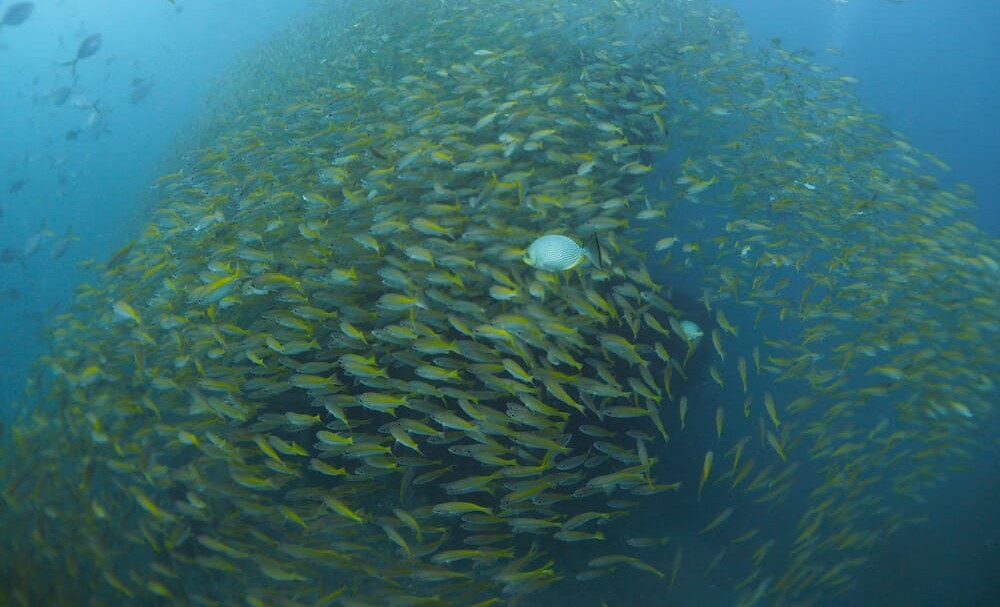
Barracudas: Schools of yellowtail and chevron barracudas often hover above the mast and wheelhouse between 14 and 18 meters, or circle slightly deeper around the main deck. Smaller pickhandle barracudas frequently mingle with snapper schools between 18 and 22 meters. A few large solitary great barracudas also hang motionless along the mooring lines, and juvenile barracuda schools are often seen around the structure.
Snappers and Fusiliers: This is arguably the most striking sight on the wreck. Thousands of snappers, including bigeye snappers (Lutjanus lutjanus), along with fusiliers, form a living wall so dense around the central deck and mast that they sometimes completely hide the ship's steel structures.
Trevallies: Golden and bluefin trevallies patrol around the hull. They execute lightning-fast strikes directly into clouds of small fish to hunt, causing dramatic, coordinated movements of panic.
B. Encrusting Life on the Hull and Deck Residents
As you tour the ship from north to south, take time to inspect the metal up close (without getting too close):
At the bow: The elevated forecastle deck offers a great overview of the sand and bow area. Porcupinefish and pufferfish frequently group together here, hovering just above the structures.
On the central deck: Around the large 3-meter cargo hatch, the structure is carpeted with sponges, small sea fans, tunicates, and colorful soft corals rooted into the steel. Looking into the gaps of the railings and rusted plating, you'll find numerous species of nudibranchs, flatworms, and tiny cleaner shrimp.
Toward the stern: Around the bridge and along the steps of the exterior metal ladders, the density of benthic predators is incredible: large scorpionfish rest on almost every ledge, stair step, or railing; lionfish drift with the current along the cabin's outer walls; and in the shadows of the large open hold and engine space (visible from the outside), large groupers remain motionless near the bottom.
C. Junction with the Sandy Seabed
If you descend to the sand at 26 meters behind the vessel, you can admire the ship's imposing propeller and rudder, both heavily colonized by encrusting marine life.
Glancing across the sandy plateau surrounding the hull, it's not uncommon to spot stingrays buried under a thin layer of sediment, or occasionally a leopard shark resting a few meters from the wreck.

5. Logistics, Planning & Practical Tips
A. Departure Points & Organization
Since the site is located in open sea east of Koh Phi Phi Leh, access is exclusively by boat. Several options are available depending on where you're staying:
From Koh Phi Phi Don: This is the shortest route. Most local centers in Tonsai organize half-day trips. The boat ride by speed boat or converted longtail takes about 20 minutes.
From Koh Lanta or Phuket: The majority of large dive centers and day-trip boats include the wreck on their regular itineraries. The boat ride is longer—usually 1.5 to 2 hours of navigation depending on the vessel type—but allows for a 3-dive day trip combination.
Since the site is only accessible to divers certified to dive down to 30 meters, requiring tailored boat logistics, dive shops generally charge slightly more for this trip than for a standard shallow reef dive.
B. Popular Site Combinations
It is rare to make two consecutive dives on the Kled Kaew during the same trip, mainly to manage nitrogen absorption. Operators very often pair the wreck with another Koh Phi Phi dive site:
Gareng Hang (Hin Klai): Located nearby, this submerged rocky pinnacle rises to 6 meters below the surface and drops to around 13–17 meters. It's an ideal second dive to offgas comfortably among anemones, branching corals, stingrays, and occasional leopard sharks.
Koh Phi Phi Leh Sites: Depending on weather and currents, boats often follow up with Bida Nok, Bida Nai, Palong, or Viking Bay to finish the day on more sheltered coral reefs.
C. Recommended Gear & Safety Management
To get the most out of the site while adhering to National Park rules, keep these equipment settings in mind:
A functioning dive computer: With a seabed at 27 meters and a deck at 20 meters, monitor your No-Decompression Limit (NDL) closely. Bottom time goes quickly on the hull.
A Surface Marker Buoy (DSMB): Due to the depth and potential currents that could drift you away from the boat during ascent, every diver should carry a DSMB in their BCD pocket to signal their position in open water.
A dive torch: Very useful even without entering the wreck. It lights up overhangs beneath railings, the bottom of open holds from the outside, and brings out the vivid red colors of scorpionfish and soft corals clinging to the steel.
Conclusion
If you're visiting Koh Phi Phi with an Advanced Open Water certification in your pocket, the HTMS Kled Kaew is definitely worth the trip. On a 47-meter-long structure sitting at 26 meters depth, you won't be doing a long technical penetration, but the density of fish per square meter makes it one of the most vibrant dives in the region.
Keep your eyes open when stabilizing near the metal: scorpionfish are so well camouflaged on the hull's ledges that it’s easy to accidentally brush against one without realizing it!
Frequently Asked Questions About Diving the HTMS Kled Gaeow
How deep is the HTMS Kled Gaeow wreck?
The wreck rests on a sandy bottom at 26–27 meters. Her main deck sits at 20 meters, and the top of the wheelhouse reaches between 14 and 16 meters depending on the tide.
What dive certification is required to visit the wreck?
You must hold an Advanced Open Water Diver (AOWD) certification or a qualification permitting you to dive to depths of 30 meters or deeper.
What is the history of the HTMS Kled Gaeow ship?
Built in Norway in 1948 (RNOMS Norfrost), she was sold to Thailand in 1956. This 47.2-meter auxiliary logistics support vessel (AKS 861) served for nearly 60 years before being scuttled on March 19, 2014.
Can you go inside the hull?
No, penetrating the hull is strictly forbidden by the National Park. But don't worry—the best part of the show happens outside! The deck and surrounding waters are where dense fish schools and reef action concentrate.
What marine species are most common on this site?
You'll observe large schools of barracudas, trevallies, bigeye snappers, fusiliers, scorpionfish, lionfish, groupers, porcupinefish, as well as numerous nudibranchs.
Where is the wreck located in relation to the Phi Phi Islands?
The vessel is submerged about 600 to 1,000 meters off the east coast of Koh Phi Phi Leh, between Pileh Bay and Viking Cave.
Is this site suitable for snorkeling?
No. Because the top of the ship rests at least 14 meters below the surface, the wreck is not accessible to snorkelers.
How big is the HTMS Kled Gaeow?
The ship measures 47.2 meters in length, 7.7 meters in beam (width), and has an empty displacement of 382 tons.
What other dive sites are paired with the Kled Gaeow?
Dive centers often pair this dive with the nearby reef of Gareng Hang (Hin Klai), famous for its anemones, leopard sharks, and stingrays. Otherwise, the second dive takes place around Koh Phi Phi Leh or the Bida Islands.
Looking to dive the HTMS Kled Gaeow wreck during your trip to Koh Phi Phi? Contact our team of local instructors at Phiphi Underwater to organize your dive trip or complete your PADI Wreck Diver Specialty in complete safety!

Comments